Policy Considerations
Pennsylvania’s nuclear opportunity extends beyond reactor construction. The commonwealth’s strength lies in its established operating fleet, industrial supply chain, and experienced talent base. Together, these assets position Pennsylvania to support projects nationwide while anchoring long-term economic value at home. In a national expansion of nuclear deployment, states that preserve industrial capacity and specialized talent are positioned to capture manufacturing, engineering, and service revenues even when projects are built elsewhere.
Policy considerations should be sequenced to reflect both urgency and structural constraints. Pennsylvania’s existing nuclear fleet and industrial base are the foundation for any future expansion. Actions that stabilize and strengthen this foundation must occur first, as delays risk the erosion of capabilities that cannot be quickly rebuilt. Subsequent steps can then focus on enabling additional deployment pathways, particularly as neighboring states refine approaches to revenue stabilization and project development. The sequence begins with actions that preserve the existing fleet and the capabilities it supports.
Stabilizing and Modernizing the Existing Fleet
Because nuclear facilities operate over multi-decade timelines, revenue visibility influences where capital investment, modernization activity, and talent retention occur. In a competitive wholesale market, preserving stable operating conditions for the existing fleet is the logical starting point. Ensuring predictable treatment of life-extension investments under state regulatory frameworks can reduce financing uncertainty. Clarifying how firm, zero-emission generation is recognized within the Alternative Energy Portfolio Standards may influence long-term revenue expectations and investor confidence. Even modest adjustments to how nuclear attributes are defined or credited may influence long-term modernization and capital investment decisions.
Stability at the fleet level protects more than generation output. It preserves the certification base, quality assurance systems, and supplier relationships that underpin Pennsylvania’s broader nuclear ecosystem. Delayed or uncertain policy signals at this stage may shift capital investment and technical expertise to other states.
Strengthening Industrial Supply Chain and Talent
Pennsylvania already maintains economic development tools that intersect directly with nuclear manufacturing and training capacity. The EDGE tax credit program, which supports large capital investment projects, could be evaluated for eligibility clarity around nuclear-grade manufacturing facilities or major plant modernization activity. Manufacturing PA programs that provide low-interest financing and technical assistance may help suppliers pursue ASME or N-stamp certification, upgrade quality control systems, or expand production lines tied to national nuclear demand.
WEDnetPA funding can offset training costs for companies expanding nuclear-related operations, while workforce development boards and apprenticeship tax credits can support scaling of skilled trades pipelines required for refueling outages, plant upgrades, or supply chain fabrication.
The Pennsylvania Energy Development Authority, through programs such as the Energy Accelerator, could support infrastructure tied to industrial expansion, including grid interconnection improvements, site preparation activities, or specialized training facilities. Although not nuclear-specific, these programs provide a foundation that could be aligned with nuclear-adjacent investments.
Coordinating these existing programs with the Nuclear Workforce and Education Roadmap underway at Penn State can improve alignment between projected labor demand and training capacity. Aligning these tools strengthens Pennsylvania’s position as a national supplier of nuclear components and expertise. Without timely alignment, suppliers may prioritize markets where demand signals and qualification pathways are clearer.
Advancing Site Readiness and Infrastructure Coordination
Site preparation reduces development risk. Prepared sites reduce early-stage uncertainty and improve time-to-decision for private investment. Pennsylvania’s PA Sites program already supports engineering, environmental studies, and due diligence to advance industrial properties. Expanding eligibility or prioritization criteria to include nuclear-ready characteristics could accelerate feasibility assessments at existing nuclear facilities, retired generation sites, or industrial brownfields with transmission access. Work can be done to build on the existing analysis by Oak Ridge National Laboratory on additional reactor siting locations in Pennsylvania.
The Office of Transformation & Opportunity’s PA Permit Fast Track program provides an existing model for interagency coordination. Applying similar coordination to nuclear-related projects could improve sequencing across environmental review, infrastructure planning, and economic development approvals without altering federal licensing authority. Early coordination is particularly important, as infrastructure and interconnection constraints can become binding before policy or financing decisions are finalized.
Improving Financial Alignment and Revenue Visibility for Future Capacity
If load growth or regional market dynamics warrant additional deployment, revenue stabilization tools may warrant further evaluation. In PJM’s competitive wholesale market structure, revenue volatility can increase financing costs for capital-intensive assets and can delay investment decisions.
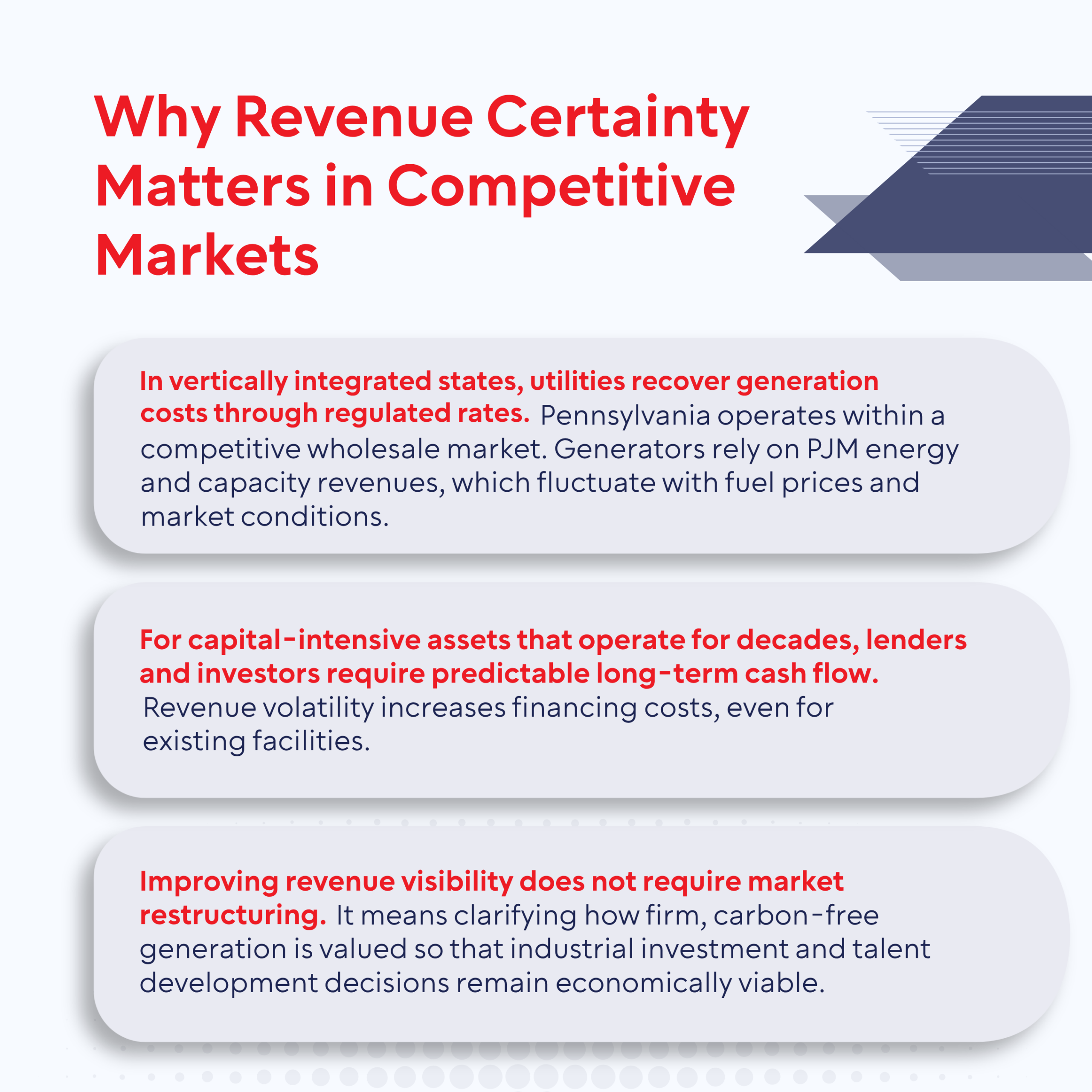
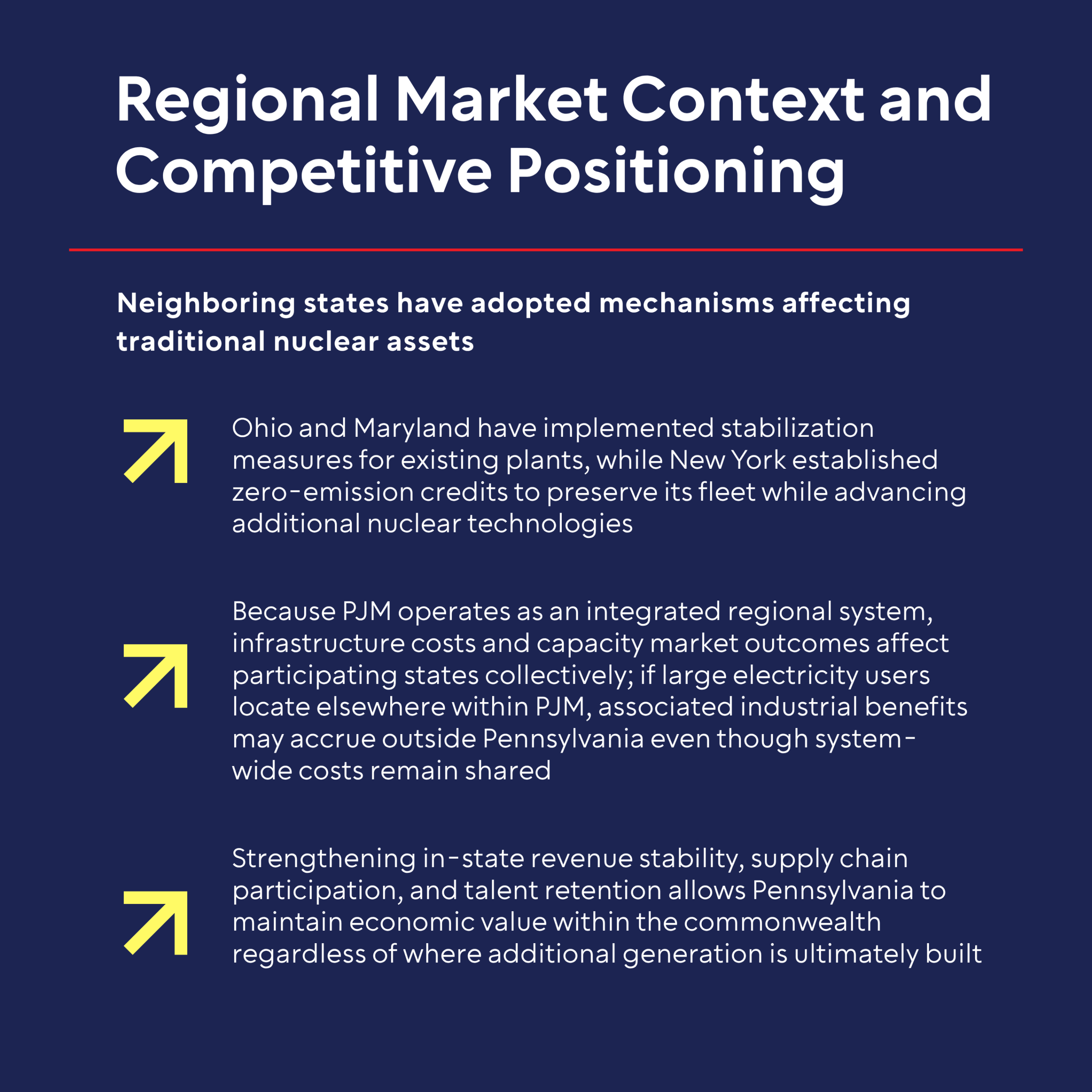
Pennsylvania’s existing statutory frameworks could be evaluated to determine whether credit-based mechanisms or long-term contracting structures can be structured within restructuring constraints. For example, adaptations to existing credit systems or targeted procurement mechanisms could provide revenue visibility while maintaining wholesale market participation. PEDA financing programs may also support early-stage project costs such as interconnection studies, engineering design, or infrastructure upgrades that occur prior to a final investment decision. When paired with federal financing tools, state participation can leverage larger capital pools while limiting public exposure.
The objective of these approaches would be to reduce first-mover uncertainty and improve bankability, rather than to replace competitive markets. As other states move to provide revenue certainty, delayed consideration in Pennsylvania may place projects at a competitive disadvantage.
Fostering Community Integration and Long-Term Public Value
Nuclear facilities provide predictable tax contributions and sustained employment over decades. Long operating lifetimes provide host communities with tax stability and planning certainty that few other infrastructure assets can match. Policy coherence across revenue stability, industrial development, and talent readiness supports durable community alignment. Pennsylvania already uses tools such as tax increment financing and local economic development incentives in other sectors. Applying similar structured frameworks to nuclear-adjacent projects may improve transparency and community benefit alignment while reinforcing long-term public value.
Sequencing these considerations is essential to maintaining competitiveness. Stabilizing the existing fleet preserves the foundation. Strengthening supply chains and talent ensures that capacity can scale. Preparing sites and aligning infrastructure reduces development risk. Only after these steps are in place can revenue tools for future capacity be evaluated with discipline. Acting on this sequence in a timely manner allows Pennsylvania to respond to growing demand while retaining the capabilities that differentiate its nuclear economy.
Recent Nuclear-Related Legislative Activity in Pennsylvania
Interest in nuclear energy has increased in the Pennsylvania General Assembly as policymakers examine how the commonwealth can sustain its existing fleet and prepare for future nuclear technologies. Several legislative initiatives have focused on enabling next-generation reactors. House Bill 2017 (2025–2026 session) adjusts state regulatory fee structures that were originally designed for large conventional reactors. The bill allows the Department of Environmental Protection to set appropriate oversight fees for small modular reactors and microreactors. This change is intended to remove a regulatory barrier that could affect deployment of smaller nuclear technologies.
Other proposals have examined how nuclear energy fits within Pennsylvania’s broader electricity policy framework. The Pennsylvania Reliable Energy Sustainability Standard (PRESS) was introduced as House Bill 2277 and Senate Bill 1190 (2023–2024 session). PRESS would update the state’s electricity portfolio structure and recognize nuclear generation within a reliability-focused energy standard. The proposal does not limit eligibility to advanced reactors and could apply to large light-water reactor technologies. The General Assembly has also directed formal study of nuclear development opportunities. House Resolution 238 (2021–2022 session) instructed the Joint State Government Commission to examine the potential role of small modular reactors in Pennsylvania’s energy system.
The legislature has also discussed potential updates to the Alternative Energy Portfolio Standards (AEPS). AEPS is Pennsylvania’s primary framework for encouraging clean electricity generation. Current law does not include nuclear energy within the credit structure. Some policymakers have explored whether future reforms could recognize the role of reliable zero-emission generation within the state’s electricity mix. These discussions remain ongoing and reflect broader national debates about how energy policy frameworks account for reliability and emissions performance.
Lawmakers have also established a bipartisan Nuclear Energy Caucus in the General Assembly. The caucus provides a forum for legislators to examine nuclear technology and economic development opportunities connected to the industry. Together these legislative efforts show growing interest among Pennsylvania policymakers in the future role of nuclear energy in the state’s electricity system and economy.
◄ Team Pennsylvania Foundation Commitments | References and Appendices ►