2026 Summer Fellows

This summer, three exceptional graduate students joined Team Pennsylvania as our 2026 Summer Fellows: Emmanuel Kraft, Kehinde Kolapo, and Tisa Larasati. They quickly immersed themselves in our work, completing research projects in high-priority impact areas and presenting their findings and recommendations to the Impact & Innovation team. Through hands-on experience, they strengthened their skills in problem-solving, communication, and presentation skills.
Beyond their project work, our fellows had the opportunity to engage with leaders from across the Commonwealth. They met with legislators and policymakers, toured the State Capitol, and connected with business leaders through the Commonwealth in Action Series. They even traded the office for the field, touring a biodigester at Dickinson College Farm in Carlisle and seeing firsthand how manure and food waste are transformed into biogas, a renewable energy source.
Read on to learn more about our 2026 Summer Fellows and how they contributed to advancing Team Pennsylvania’s work throughout the summer.
Meet the Fellows
Emmanuel Kraft
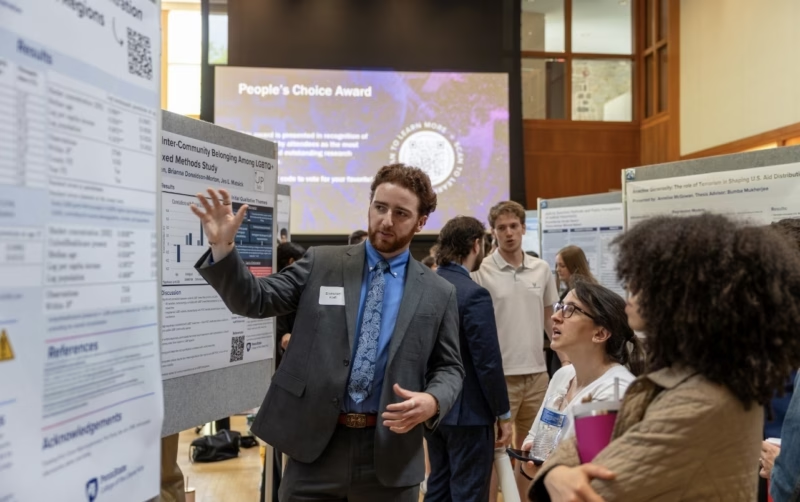
Emmanuel earned his Master of Public Policy from Penn State University, where he zeroed in on social policy and the kind of complex, systems-level problems that do not have easy answers.
This summer, he tackled two projects for Team Pennsylvania’s agriculture work: digging into strategies that could cut food waste across Pennsylvania’s farms, and supporting the narrative creation for multiple grant opportunities. A native French speaker and dual citizen, Emmanuel brought a genuinely global perspective to the table, one that has helped him build relationships and see issues from angles others might miss.
Primary Project: Food Waste Reduction and Circular Economy Models in Pennsylvania
During his time as a Team Pennsylvania fellow, Emmanuel researched how Pennsylvania can reduce food waste and grow a more circular food economy, an issue with significant financial stakes for the Commonwealth. Drawing on national data from ReFED and the Environmental Protection Agency alongside Pennsylvania-specific figures, he found that the state generates over 2 million tons of surplus food each year, worth an estimated $13.5 billion, while 1 in 8 Pennsylvanians face food insecurity. Using a nationally-recognized framework for addressing food waste that spans prevention, rescue, and recycling, he evaluated which interventions were best suited to Pennsylvania’s economy and existing infrastructure.
Emmanuel then assessed the strengths and gaps in Pennsylvania’s current food waste ecosystem. He highlighted the Pennsylvania Agricultural Surplus System as a national model for reimbursing farmers who donate surplus crops, a robust network of food rescue organizations such as 412 Food Rescue and Sharing Excess, and growing composting operations like Bennett Compost. At the same time, he found that these efforts remain fragmented, and that Pennsylvania lags neighboring states like New Jersey and New York on policies such as statewide organics diversion mandates and food donation liability protections.
Based on this analysis, Emmanuel outlined three strategic opportunities: building a coordinated farm-to-market recovery system that connects farmers with food banks and secondary markets, creating a statewide network to unite Pennsylvania’s food rescue organizations under shared technology and logistics, and growing a circular food economy that turns food byproducts into new products through research partnerships and investment.
Kehinde “Kenny” Kolapo

Kenny is pursuing a dual title Ph.D. at Penn State University, pairing entomology, the study of insects, with microbiome sciences, the study of the microscopic organisms that shape soil, plants, and food systems. It is a rare combination, and one that puts his research squarely at the intersection of agriculture, biology, and innovation.
This summer, Kenny led a statewide assessment of Pennsylvania’s grain processing capacity. He also contributed to a project exploring where high-performance concrete could strengthen infrastructure across the Commonwealth.
Off the clock, Kenny continued his lifelong athleticism, playing soccer, volleyball, and swimming competitively. He credited sports with teaching him teamwork, resilience, and how to perform under pressure: lessons he carried straight into his research.
Primary Project: Pennsylvania Grain Processing Ecosystem Assessment
Kenny led a statewide assessment of Pennsylvania’s grain and milling processing capacity, surveying eighteen processors across fourteen counties between June and July 2026. Respondents included feed mills, food-grade mills, industrial processors, craft maltsters, and specialty operations, reflecting the diversity of an industry that converts Pennsylvania-grown grain into feed, food ingredients, malt, and specialty products. Kenny’s central premise was straightforward: processing capacity is the link connecting farms to buyers and markets, and the more of that value-added work that happens in-state, the more economic value stays in Pennsylvania’s agricultural economy.
The survey results pointed to underused potential rather than a shortage of infrastructure. Ten of the eighteen respondents reported using less than 75 percent of their current processing capacity, and fourteen said they want to expand despite that unused room, suggesting growth is limited less by physical capacity than by customers, financing, or operational readiness. Corn emerged as the most widely processed grain, handled by fifteen respondents, making it a natural starting point for connecting processors with buyers, while other grains such as oats, wheat, and specialty crops each require their own market conversations. Expansion barriers were spread across buyer access, regulatory compliance, capital, workforce, and facility space, with no single obstacle dominating, meaning solutions will need to be tailored to each processor’s situation rather than applied uniformly.
Kenny translated these findings into practical next steps: 1) focus initial outreach on one or two products where both processor interest and buyer demand can be confirmed; 2) ask potential buyers directly what they need in terms of quality, volume, and delivery; 3) tailor support to each facility’s situation by helping underused processors find customers and helping near-capacity processors plan concrete expansions; 4) connect farmers, processors, and buyers around the specific requirements of each product; and 5) gather more information from the Northwest and Northeast counties, where survey participation was thin before recommending any shared equipment or new facilities. Throughout the assessment, his recommendation was to prioritize growing production within Pennsylvania’s existing processing facilities and to measure progress through real signals like purchase orders and increased sales.
Tisa Larasati

Tisa is pursuing a Master’s degree in Public Policy and Management at Carnegie Mellon University, with a focus on economic development and technology policy–the kind of work that sits at the crossroads of business and government.
This summer, she led research on how trade policy and broader economic pressures were affecting farmers across Pennsylvania. She also evaluated the economic impact of potential sites for a new mass timber processing facility, a plant that turns wood into a strong, sustainable building material, and modeled the economic impact those investments could have across the Commonwealth, using REMI’s modeling software.
Tisa also kept a personal streak alive: 10,000 steps, every single day. What started as a fitness goal became her go-to way to clear her head and spark new ideas for whatever challenge she was tackling, at school or at work.
Primary Project: The Impact of the U.S. Tariff Policy on Pennsylvania Agriculture (2006–2026)
Tisa examined how two decades of U.S. tariff policy have affected Pennsylvania agriculture, drawing on data from 2006 through 2026. Her central finding reconciles two facts that seem contradictory: Pennsylvania lost about 9,400 farms since 2006, a decline spread across every major agricultural region, while the state’s agricultural exports roughly doubled over the same period. Export value measures market access, she found, not whether the operations behind that value can survive a shock, and tariffs are not the origin of Pennsylvania’s farm decline, but they compound an already compressed cost-price squeeze by raising input costs while retaliation reduces demand for exported goods. That farm loss primarily came from consolidation as seen in the 2025 Pennsylvania Agriculture Economic Analysis.
Tisa also traced the decline to rising costs rather than falling demand: diesel prices, fertilizer expenses, and an aging farmer population without enough successors have squeezed margins for two decades, and tariffs act as a multiplier on both sides of that squeeze, raising the cost of imported inputs like potash-based fertilizer while closing off export markets. Her analysis of three tariff-exposed commodities, soybeans, dairy, and wood manufacturing, found that the resulting costs land overwhelmingly on small-scale operations: farms under $50,000 in sales accounted for 77 percent of the farms lost between 2017 and 2022, even as statewide farm sales rose 31 percent on the strength of larger, export-oriented operations. She also found that Pennsylvania’s existing trade-promotion and resiliency programs have no mechanism that responds specifically to a tariff shock, and looked to New York’s direct-payment tariff relief program and Ohio’s push into Southeast Asian markets as models Pennsylvania could adapt.
Based on this analysis, Tisa recommended three complementary opportunities: preparing a tariff-shock relief program for small and mid-sized farms facing verified losses, establishing a low-interest bridge loan to help farms manage tariff-driven cash-flow gaps, and building a recurring trade mission to Southeast Asia, starting with Vietnam, to diversify export markets and reduce Pennsylvania’s exposure to retaliation. She positioned Team Pennsylvania as the convener that builds the evidence base and connects partners, while state agencies administer the programs directly.